
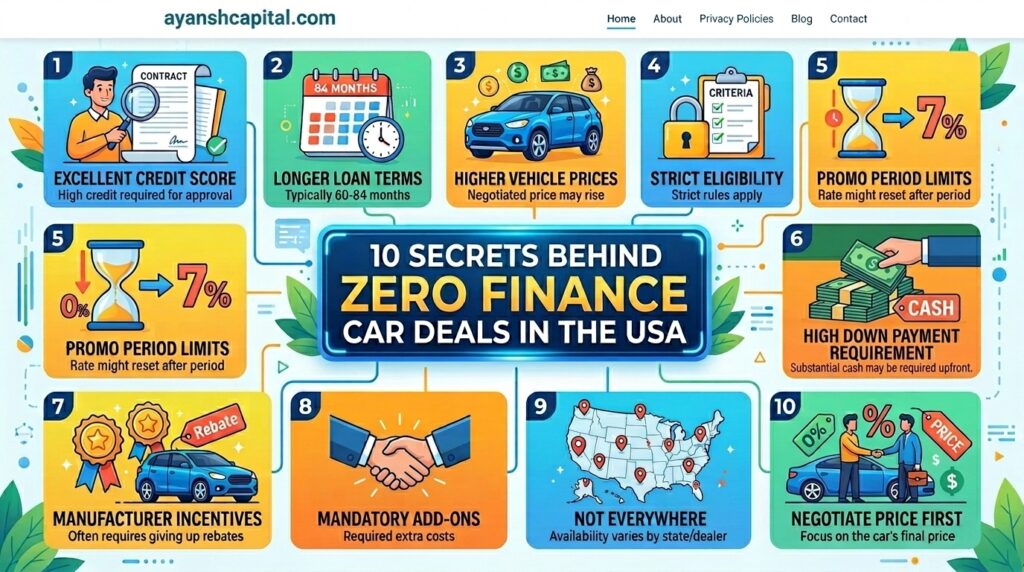
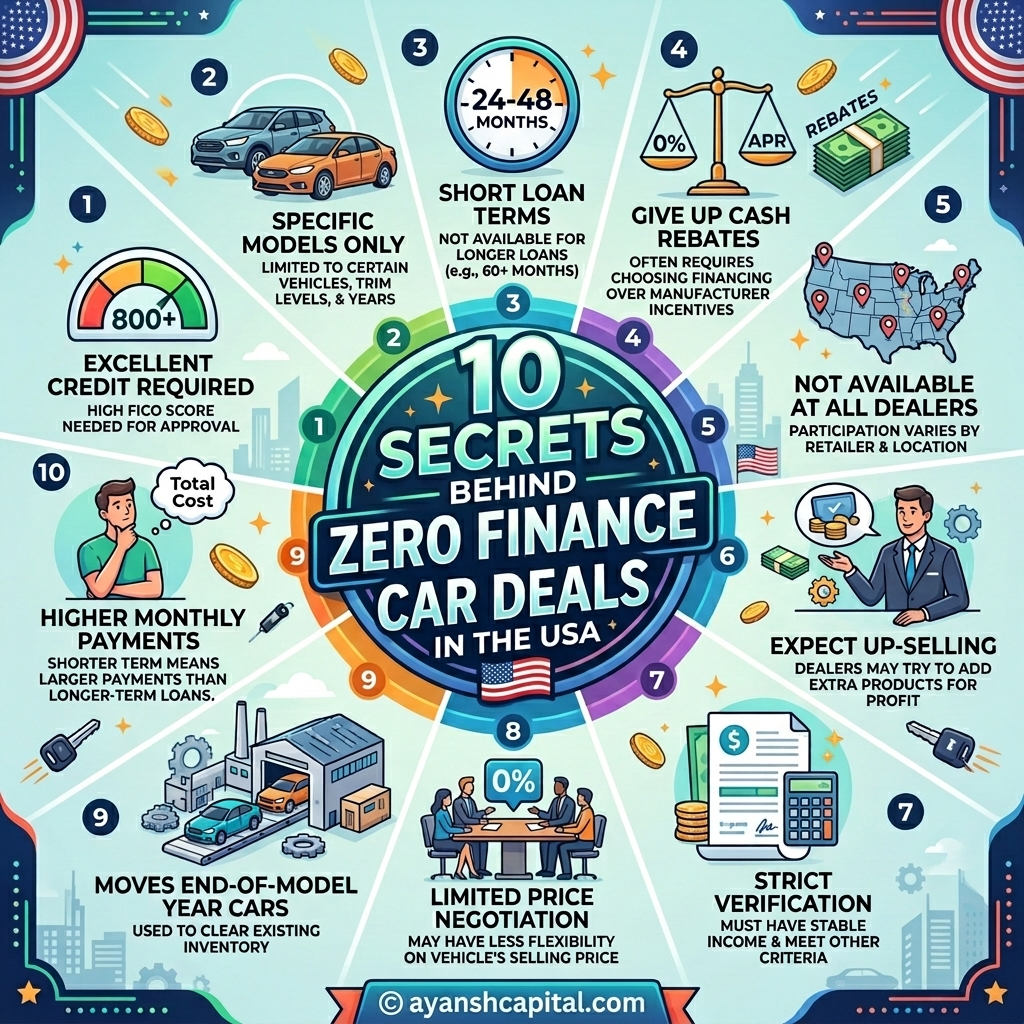
10 Secrets Behind Zero Finance Car Deals in the USA
Family Happiness and Your New Car: The Real Truth Behind the Best zero finance car deals
Seeing a bright “0% APR” sign outside a car showroom tempts every parent. But would a bank really give away money without charging interest? After all, we work day and night, saving every single penny for our children’s future! Today, we will clear up this confusion. Let’s understand in simple, everyday language how these zero finance car deals actually work, so you can bring home a safe car for your family without wasting your hard-earned money on unnecessary interest.
1. The Real Difference: Interest Rate vs. APR in zero finance car deals
When taking a loan, hearing ‘Interest Rate’ and ‘APR’ from the dealer might sound like the exact same thing, but in real life, there is a massive difference.
- Interest Rate: This is simply the rent the bank asks for in exchange for giving you money.
- APR (Annual Percentage Rate): This is the complete breakdown of your total expenses.
A Family Example: Think of it like buying a new bicycle for your child’s birthday. The actual price of the bicycle is the ‘Interest Rate.’ But if you add the cost of transporting it home, the fee to assemble the wheels, and the taxes, that total becomes the ‘APR.’ An auto loan’s APR includes file charges and the dealer’s hidden fees. When you secure one of those genuine and clean zero finance car deals, it means that not only the interest, but all those sneaky hidden fees have been waived off. Every single penny of your hard-earned money goes directly toward owning your car.
2. The Family Math of 0% APR: How It Saves Your Household Budget
The math behind this isn’t some boring textbook formula; it is as straightforward as your daily household budget. Just imagine a mother named Sarah, who buys a $30,000 car to ensure her children travel safely, and she chooses a 60-month (5-year) loan:
- Total Loan Amount: $30,000
- Time: 60 months (5 years)
- Monthly Principal Payment: $30,000 ÷ 60 = $500
- Monthly Interest: $0
- Total Monthly Payment: $500
The Reality Check (0% APR vs. Standard 5% APR): If Sarah had taken a standard 5% APR loan instead of 0%, her monthly payment would have jumped to $566. Just think about it, over those 5 years, she would have paid $3,968 extra of her hard-earned money purely in interest! That would make the actual cost of the car nearly $34,000. This proves that these zero finance car deals are not just a marketing gimmick. These deals directly save your family almost $4,000. That is $4,000 that can be used for your children’s education, a major household need, or a rainy day fund.
3. The Biggest Question: Why Would Anyone Give Money for Free?
We all know that nothing in this world is truly free. Because of inflation, the $30,000 today will be worth much less 5 years from now. So why would anyone willingly take a loss?
The Real-Life Truth: If you walk into a traditional bank (like Chase or Bank of America) and ask for zero finance car deals, they will politely say no. Their entire purpose is to hold people’s savings at a low interest rate and lend it out at a higher rate to make a profit. It is financially impossible for a bank to run its business by forgiving your family’s interest.
4. The Economics of the Dealership’s Own Lenders (Captive Finance Companies)
The institutions turning these 0% deals into reality aren’t traditional banks, but the captive finance companies owned by the car manufacturers themselves. For example:
- Toyota Financial Services for Toyota
- Ford Motor Credit Company for Ford
- Nissan Motor Acceptance Corporation for Nissan
How does this work? Just like a clothing merchant sells off old sweaters at a discount when winter ends to make room for fresh stock, car companies do the exact same thing.
- Clearing Inventory: When cars sit in the showroom getting old, the company loses a lot of money every single day. To move these vehicles quickly, they drop the interest rate to 0%.
- The Company’s Support: The main automaker compensates the finance company for the loss they take on the loan. For them, taking a small hit on the interest is far better than letting the cars turn into scrap metal.
- Attracting the Crowd: A 0% APR sign pulls families right into the showroom. The profit made from actually selling the car is much bigger than the loss taken on the loan.
5. My Final Take
As your well-wisher, my advice to you is that finding a true 0% APR deal is like striking a gold mine, but you must be a smart and sensible buyer for your family.
Remember, these deals are not handed out to just anyone. Your family’s financial reputation (credit score) needs to be excellent for this (usually 740 or above). Dealers often use the temptation of this 0% loan to avoid reducing the actual price of the car (Sticker Price).
An Elder’s Solid Advice: When you walk into the showroom, negotiate the total ‘Out-the-door’ price exactly as if you were paying with your own hard-earned cash from your pocket. Only start talking about the loan after the final price is fully locked in.
Getting a 0% loan is not a favor from a bank; it is the art of understanding the company’s desperation to sell their cars and seizing the right moment to take advantage of one of those excellent zero finance car deals. Save your family’s hard-earned money and use these fantastic deals to begin a safe, joy-filled journey!
Unmasking the Truth for Your Family: Who Really Funds zero finance car deals and Are They a Hidden Trap?
Have you ever spotted a massive “0% APR” banner while driving your kids to school? For hardworking parents, borrowing tens of thousands of dollars for free sounds like an absolute dream. But as someone who values your family’s savings, I see how these zero finance car deals confuse honest buyers. Let’s sit down like friends and understand if they are a brilliant household opportunity or just a cleverly disguised trap.
1. Why Your Trusted Local Bank Will Never Offer This
Why do traditional banks (like Chase or Bank of America) avoid these offers?
- The Value of Your Money: Banks pay you interest to keep your savings safe, then lend that money to others at a higher rate to feed their own families.
- A Guaranteed Loss: If a bank lends at 0%, inflation and processing costs mean they lose money. Giving away free money destroys their livelihood.
- The Reality: You can never demand zero finance car deals at a local credit union. It goes against the basic rules of protecting community money.
2. The Real Masterminds: The Automaker’s Lenders
If banks aren’t handing out free money, who is? The car manufacturers themselves.
- Who They Are: True 0% loans come from in-house lenders, like Ford Motor Credit or Toyota Financial Services.
- The Family Rescue Plan: Imagine a beautiful family SUV sitting on the lot for months, losing value daily. To stop this financial bleed, the automaker tells its in-house lender to offer a 0% loan to attract caring parents.
- Who Pays the Bill? The in-house lender takes a loss on the interest, but the main automaker repays them. Covering this small loss is much better than letting a great car rust away.
3. The Emotional Pull: The Psychology Behind the Trick
0% APR isn’t an illegal scam, but it is a calculated trick playing on our desire to provide the best for our loved ones.
- A Father’s Dream: Imagine a devoted father named Mike. He test-drives a car, imagines his kids safely buckled up, and connects emotionally with it.
- The Heartbreaking Switch: In the finance office, the dealer checks Mike’s history. Despite a solid 720 score, Mike is told the 0% offer is only for “Super Prime” scores of 780+.
- The Dealer’s Win: Offered a standard 6% rate instead, Mike signs anyway because his heart is set on that specific car. The emotional trick worked beautifully.
4. The Hidden Traps in the Fine Print
Even with a flawless credit score, you must protect your family from hidden catches.
- The Short-Term Squeeze: The fine print often restricts 0% loans to just 36 months. Dividing a $40,000 family vehicle by 36 months creates a crippling $1,100+ monthly payment, destroying your grocery budget!
- The Family Math: You frequently see “0% APR OR $3,000 Cash Back.” You cannot have both. Taking the $3,000 upfront discount with a standard bank loan often leaves more money in your pocket for your children’s future.
My Final Take on zero finance car deals
Getting approved feels like a victory, but don’t let excitement blind you. Always fiercely negotiate the out-the-door price first, just as if you were paying cash. Factor in total costs, like auto insurance, to protect your family. A heavy insurance bill can wipe out your interest savings. Most importantly, have the willpower to walk away if the dealer plays with your emotions.
The Hidden Catch Behind zero finance car deals: Your Credit Score
Many hardworking people face a rude awakening: their credit score simply isn’t “perfect” enough for big promotions.
- The “Super Prime” Requirement: Lenders demand zero risk for zero interest, strictly reserving these deals for borrowers with spotless histories.
- The 720 Illusion: A 660 score gets a standard loan, and a 720 might secure a family home. But “free money” requires a stellar 750+ score and a flawless history of paying off past family cars on time. Even with a high score, a Debt-to-Income ratio over 40% can still cause a denial.
The Family Math Dilemma: 0% APR vs. Cash Rebates
Dealerships often force a choice: take the 0% APR, or take a massive upfront cash rebate and secure your own standard loan. Let’s look at a $30,000 car over 60 months.
- Option A (The 0% Route): Finance the full $30,000 at $500 a month. Total out-the-door cost: $30,000.
- Option B (The Rebate Route): Take a $3,500 cash rebate, dropping the price to $26,500. Finance that smaller amount at a standard 5% APR ($500.09 monthly). Total out-the-door cost: $30,005.
The Shocking Reality: The final cost is nearly identical! The $3,500 upfront rebate completely covers the $3,505 in interest you pay over five years.
When to Protect Your Wallet
The marketing behind zero finance car deals is brilliant. It causes loving parents to focus only on the interest rate while forgetting the total vehicle cost. If a rebate is larger than $3,500, or you plan to trade the car in early as your family grows, taking the upfront cash is mathematically cheaper and safer.
Never let a 0% rate stop you from negotiating the total price first. If you built that elite 750+ score, always do the math on the cash rebate before signing. It might just be the secret to securing the best zero finance car deals and saving your family thousands of dollars!
Your Ultimate Family Guide: Secure the Best zero finance car deals
Spotting a glowing “0% APR” banner outside a dealership is tempting. But as a parent, your first instinct is likely protection—wondering how to keep your family’s hard-earned savings safe.
Securing true zero finance car deals is completely possible with the right approach. Let’s break down a simple, four-step guide to help you navigate the showroom floor without losing your peace of mind.
Step 1: Polish Your Financial Reputation in Advance
Your credit score acts as your family’s shield. Never let the dealership be the first to check where you stand.
- The 3-Month Rule: Check your credit report at least 90 days before shopping. This gives you time to clear up any surprises.
- The 750+ Target: Lenders look for excellent credit and a solid history of paying off auto loans.
- A Family Example: Imagine sitting down to pay off a credit card, bringing the balance from $10,000 down to $1,000. That single step of discipline can instantly boost your score past the 750 mark, unlocking the door to the best zero finance car deals for your household.
Step 2: Read the Fine Print Like a Detective
Advertisements are designed to build excitement, not necessarily to give you the complete picture.
- Go to the Source: Skip the flashy flyers and check the official automaker’s website directly.
- Watch the Clock: The 0% offers are usually restricted to shorter terms, like 36 or 48 months. Expecting a relaxed 7-year free loan will only lead to disappointment.
- Inventory Clear-Outs: Automakers rarely offer zero-interest deals on their brand-new, highly requested SUVs. These promotions are typically reserved for last year’s leftover stock or base models they need off the lot.
Step 3: Brace for the “Monthly Payment Shock”
Zero percent interest saves you thousands, but the shorter repayment window means a much higher monthly bill.
Let’s look at the simple math for a $30,000 family car:
- Over 60 months: A standard loan keeps your payments at $500 a month.
- Over 36 months: The accelerated 0% timeline pushes your payment to a heavy $833 a month.
Advice for Parents: Sit down at the kitchen table and ask yourself honestly—can your family easily handle an $833 car payment without cutting into your emergency fund or your children’s savings? Tying up your household budget just to avoid interest is never a good trade-off.
Step 4: Arm Yourself with a Backup Plan
Never walk onto a showroom floor completely dependent on the finance manager for approval.
- Get a Plan B: Visit your local credit union a few days early to get pre-approved for a standard loan.
- Block the Bait-and-Switch: Imagine falling in love with a car, only for the dealer to say your score didn’t qualify for 0%, but they can offer 7.5% instead. Without a backup plan, panic sets in and you might sign.
- The Power in Your Hands: With a pre-approval letter in your pocket, you hold the leverage. You can simply say, “If I don’t qualify for the zero finance car deals, I will just use the 4.5% approval I already secured from my bank.” This simple document protects your family from inflated dealer markups.
The Unfiltered Truth: Pros, Cons, and Cash Rebates
The Good Side: When you secure genuine zero finance car deals, 100% of your payment goes toward building equity in the car. You aren’t losing money to bank interest, keeping your household financially secure.
The Catch: Dealerships frequently make you choose between the 0% rate OR an upfront cash rebate (like $4,000 off the sticker price). You cannot have both.
The Smart Pivot: If the 0% door closes, don’t despair. Shift gears, take the $4,000 cash rebate to lower the principal price, and use your credit union loan.
- The Family Math: Taking that $4,000 discount upfront combined with a standard 4.5% loan often leaves more cash in your wallet than paying full sticker price at 0% interest. That is extra money you can put toward a wonderful family vacation or your children’s education.
My Final Take: Protect Your Household Wealth
Chasing zero finance car deals is a psychological game designed by brilliant marketers to get you onto the lot and emotionally invested in a vehicle.
Never let the new car smell or the promise of a 0% rate cloud your judgment. Bring a calculator, compare the total out-the-door price with and without cash rebates, and always keep the willpower to walk away. The dealership’s goal is to maximize their profit; your goal is to protect your family’s hard-earned wealth.
How comfortable are you with the monthly payment math outlined in Step 3, and would you like to explore more ways to calculate the true cost of ownership for your specific household budget?
The Truth About 0% APR: Are zero finance car deals Just a Show?
Just last week, my neighbor Mark was thrilled. He saw a massive billboard advertising “0% APR” (an interest-free loan) on a new SUV for his kids. He truly believed that without paying a single extra penny in interest, a gleaming car would soon be parked in his driveway.
But in today’s world, where standard car loan rates are hovering around 6.5% to 7%, as a genuine well-wisher, I had to tell him the reality. Are car sellers suddenly doing charity? Absolutely not. Let’s look at the real truth behind this advertisement through the eyes of a family.
The Showroom’s “Sweet Temptation”
To put it plainly, zero finance car deals are not an illegal scam. If you manage to meet every single one of their tough conditions, you truly won’t pay any interest.
But in real life, this is just a sweet temptation designed to pull families out of their homes and into the showroom. Their real motive is to get you to take a test drive, see your kids playing in the back seat, and connect so deeply with that car from the heart that you are willing to take it home at any cost.
Hidden Conditions and Heartbreaking Truths
When Mark happily sat across from the dealer, his dream shattered. TV commercials never mention these things:
- The $3,000 Cash Sacrifice: You have to make a very heavy choice: either take the 0% interest rate, or take the $3,000 cash rebate offered on the car’s price. You cannot have both at the same time. You could have used this $3,000 to pay your children’s college fees or fix up your home, but in the greed for free interest, you end up paying the full price of the car.
- The High Wall of a 750+ Score: The absolute best zero finance car deals are only given to families with a credit score above 750 who have paid all their past installments perfectly on time for years. If you made even a single mistake in the past, the dealer will take advantage of your emotions and immediately tie a heavy 7% loan around your neck.
- The Heavy Shock of the Installment: These companies do not give you a comfortable 72 months to pay off the money. They squeeze it into just 36 months (3 years). Just imagine, a monthly payment of $1,100+ for a $40,000 car! This can completely ruin the budget for groceries, milk, and family vacations for any normal household.
10 Simple Things: How to Turn the Deal in Your Family’s Favor
- APR vs. Interest Rate: Interest is just the cost of borrowing, while APR includes all the hidden file charges. When you get a true deal, both become zero.
- Why Your Banks Step Back: Your trusted banks feed their employees’ families by earning interest on people’s savings, so they can never offer free zero finance car deals.
- The Companies’ Own Banks: These loans come directly from the car companies’ own special lenders. Their goal isn’t to earn interest, but to sell the old cars standing in their showrooms as quickly as possible.
- Greed and Disappointment: 85% of families reach the showroom drawn by this temptation, but get rejected due to bitter conditions and sadly end up taking an expensive 6-7% loan.
- No Forgiveness in Credit: Even with a 750+ score, if your family was late on even a single payment in the last 7 years, they will immediately say no.
- A Heavy Blow to the Budget: A short loan of 36-48 months means a massive installment of over $800 every month, which can snatch away the little joys of your home.
- No Double Joys: You cannot enjoy two perks at once. Either take the 0% loan or take the massive discount on the car’s price.
- The Family Math of Discounts: If you take a $4,000 cash discount on the car, you have to borrow less money. Paying your own bank’s 5% interest on that reduced price is often much cheaper than paying the full price for zero finance car deals without the discount!
- Pros and Cons: The benefit is that every penny you pay goes toward the car’s price. The downside is that the installments are incredibly heavy, and you pay the full price for a car the company just wants to get rid of.
- Your Alternative Path: If you don’t get the 0% loan in the showroom, don’t be afraid. Ask for the cash discount and use the loan you already secured from your own bank. Or get a 3-year-old car, which is always the wisest decision for a growing family.
An Elder’s Honest Advice (My Final Take)
The smell of a new car can make anyone emotional, but always remember that the person selling the car wants to increase their profit. As the head of the household, your biggest responsibility is to financially protect your children and your family.
Do not make a sentimental decision just by looking at the “free money” ads. Always keep a pen and paper handy, and calculate exactly how many dollars are leaving your pocket in the end. Only with a spotless record and the right timing is it possible to get genuine zero finance car deals.
If this heavy math shakes your household budget, walk out of the showroom immediately without any shame. Taking a large cash discount and getting a normal loan from your local bank proves that zero finance car deals are not the only way to find happiness. Make wise choices and always keep your family’s joy secure!