
Credit Score for Car Loan: Get Approved with Bad Credit
Family Needs and Your Credit Score for Car Loan: A Genuine Start
Can everyday life in America be imagined without your own car? Whether it is commuting to work, safely dropping the children at school, or picking up essential household groceries, a reliable car is a fundamental necessity for every family. However, when your Credit Score for Car Loan is low, this dream begins to feel slightly difficult and stressful.
Lenders view your Credit Score for Car Loan as a reflection of your financial responsibility. If this score is low, you might face higher interest rates or stricter terms. But as the head of a family, you do not need to be discouraged! Bad credit absolutely does not mean that the doors are closed for you. With the right strategy, genuine information, and a little bit of wisdom, you can easily bring your favorite car home.
Let us understand this entire journey in simple language so that you can protect your hard-earned money.
Here is a detailed breakdown of how your credit tier affects the average APR for both new and used vehicles:
The Math of Your Credit Score for Car Loan and Its Direct Impact on Your Wallet
Car financing in America relies entirely on your credit history. How banks view your data has a direct impact on your household budget.
- The Banks’ Perspective (FICO Auto Score): When you apply for a loan, lenders do not just look at a general Credit Score for Car Loan. They focus on a specific ‘FICO Auto Score’ ranging from 250 to 900. This score tells them how responsible you will prove to be in paying your car installments.
- The Relationship Between Score and Interest Rate: Your Credit Score for Car Loan determines how much interest (APR) the banks will charge you. The lower the score, the more the banks will fear losing their money, and they will compensate for this by charging you higher interest.
Let us understand this math from the perspective of an ordinary family:
Suppose you chose a good second-hand car for your family for $20,000. But if your Credit Score for Car Loan is between 300 and 500 (which is called ‘deep subprime’), the bank can charge you a massive interest rate of up to 21%.
Now look at this over 5 years (60 months) of installments. From your blood, sweat, and tears, you will be paying approximately $12,000 extra just in interest! This means your $20,000 car will ultimately cost your family $32,000. Just think, this is money that could have been used for your daughter’s college fees or a major household expense. Therefore, understanding these statistics is not just math, but a matter of your family’s financial security.
A Solid Roadmap to Bringing a Car Home Despite a Bad Credit Score for Car Loan
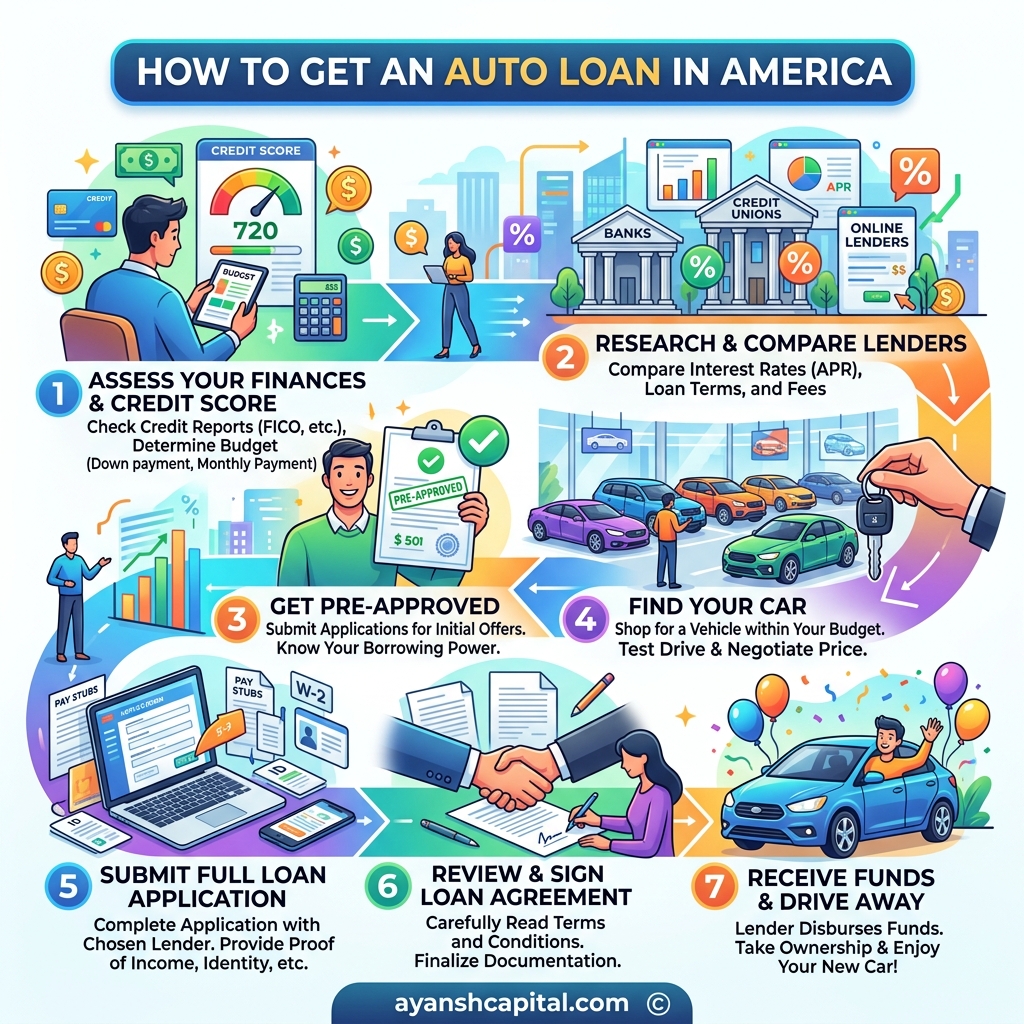
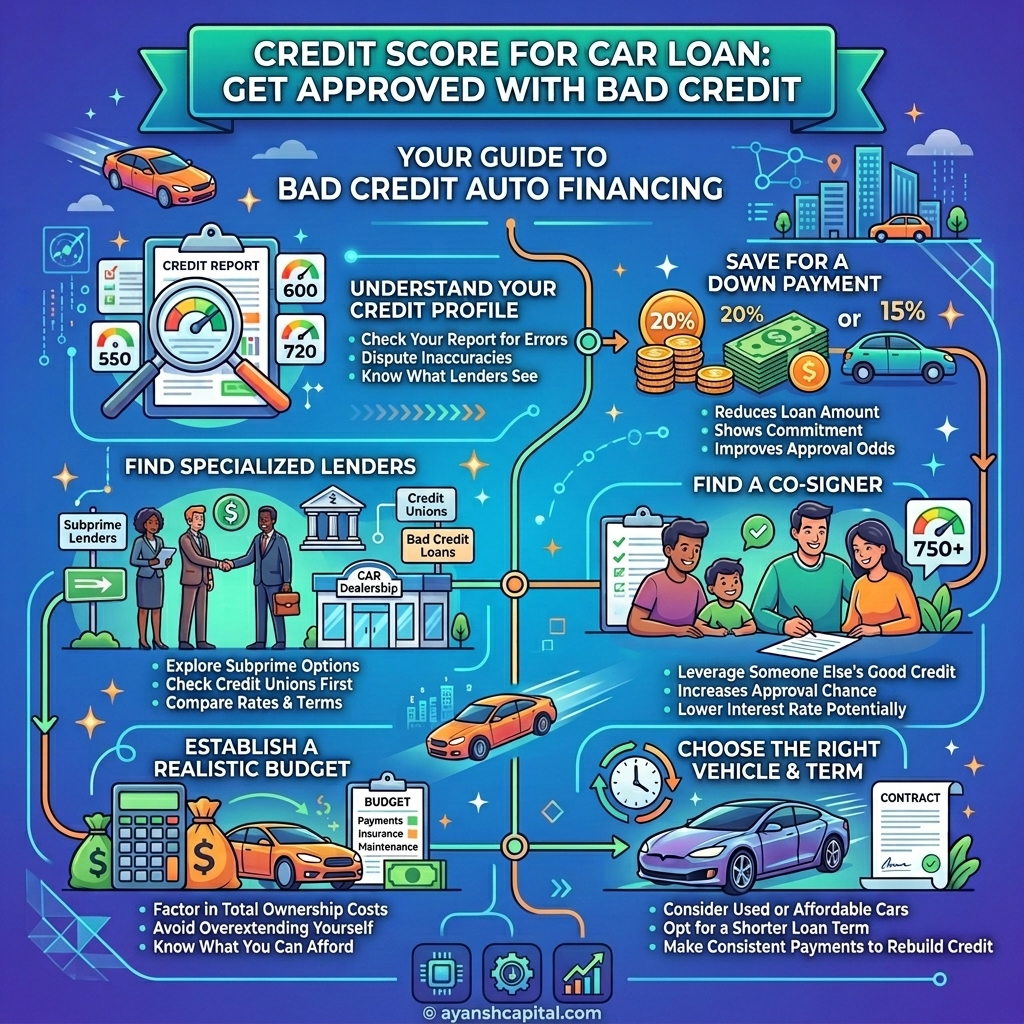
Walking straight into a car showroom without solid preparation can be your biggest financial mistake. To increase your chances of approval and protect your family’s money, take these 4 steps with love and wisdom:
1. Check Your Credit Report and Correct Mistakes Sometimes your Credit Score for Car Loan is low simply because an old or incorrect piece of information is recorded on the report, which is actually not your fault at all.
- A month or two before buying a car, visit AnnualCreditReport.com and pull your free report.
- If you see a debt that you have already paid off, immediately send a dispute to the credit bureaus. This can instantly improve your score.
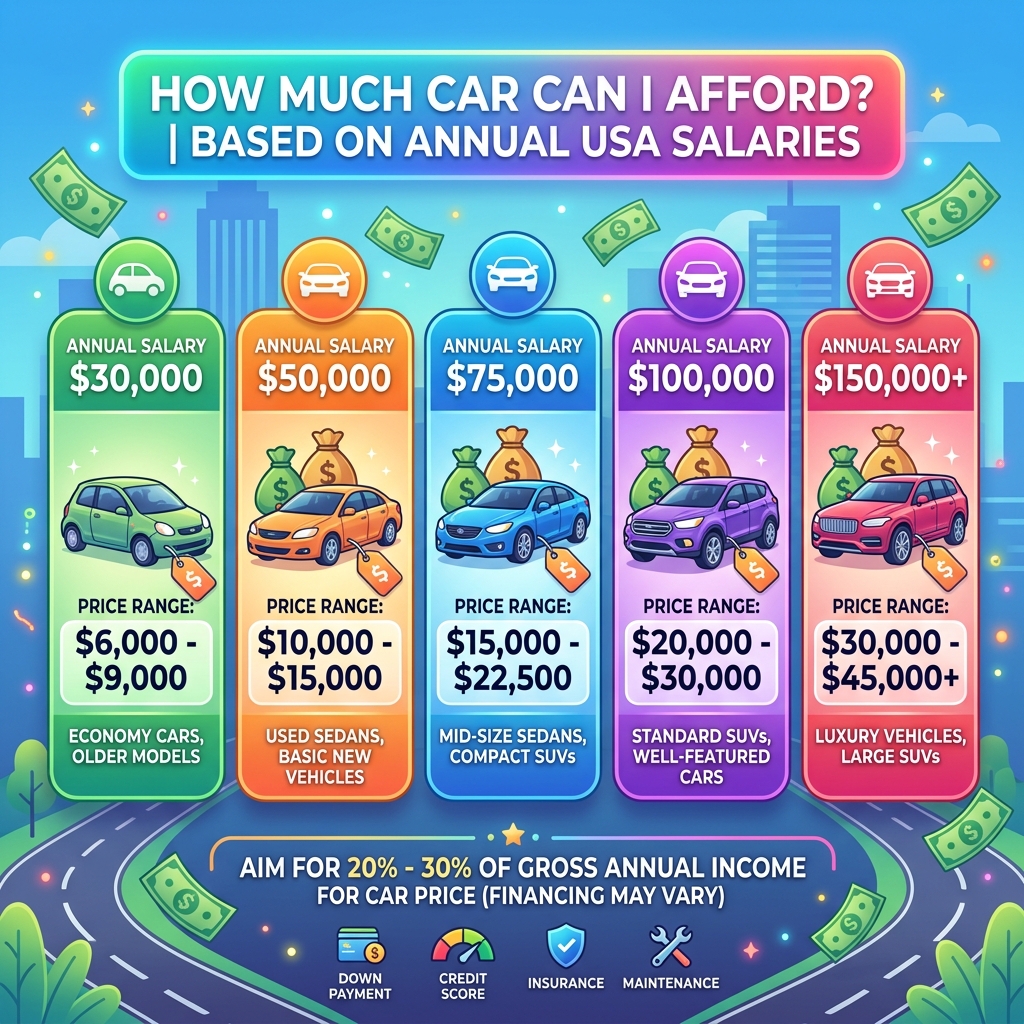
2. Make a Good Down Payment from Your Own Savings (Aim for 20%) When you put down a substantial amount of cash from your own pocket, the banks’ fear is significantly eliminated.
- If you pay 20% of the car’s price yourself, you are taking out a much smaller loan. Because of this, banks happily grant approval.
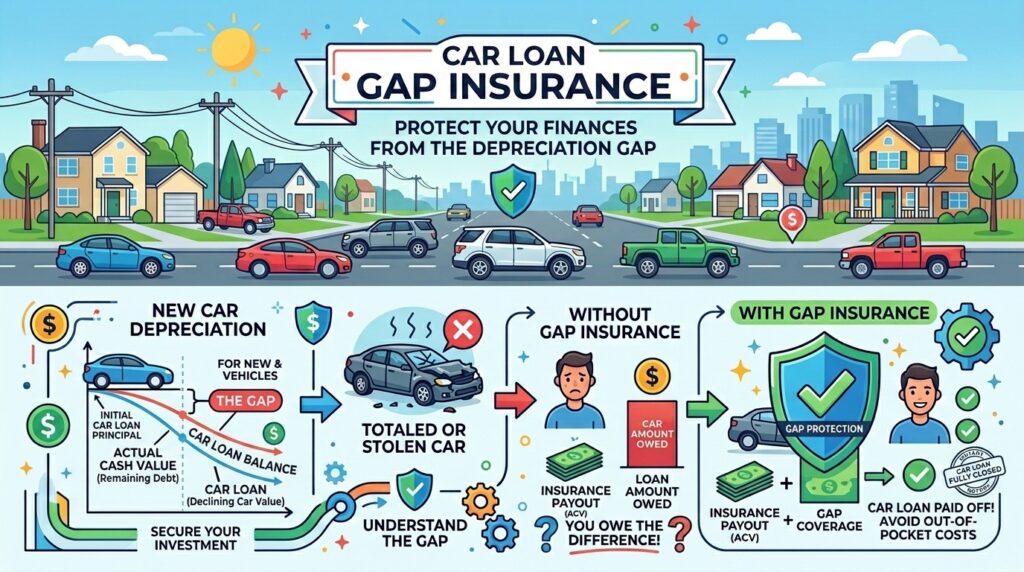
- A car begins to lose its value the moment it leaves the showroom. This savings protects you from the dangerous situation where the car’s value drops below your loan amount.
3. Gather Proof of Your Steady Income For people whose Credit Score for Car Loan is low, lenders want to see how stable your job and income are so that the burden of installments does not fall on you.
- Lenders want to see a steady monthly income of at least $1,500 to $2,000.
- Be sure to carry your pay stubs from the last 30 days, tax forms (W-2) from the last 2 years, and an electricity or water bill in your name.
4. Make Someone Close to You a ‘Co-Signer’ (Very Effective but a Huge Responsibility) If your Credit Score for Car Loan is extremely bad, you can seek the help of a very close person (who has excellent credit).
- The bank will determine the loan approval based on that close person’s excellent credit instead of yours, which will get you a cheaper loan.
- But beware: This is a matter of trust in relationships. If you miss even a single installment, along with yours, that person’s credit will also be completely ruined. Only take this step when you are 100% confident about paying the installments on time.
Who Actually Gives Money for a Car to Those with a Low Credit Score for Car Loan?
When the score is low, knocking on the right door is absolutely crucial. Applying in the wrong place can drop your Credit Score for Car Loan even further. Here are 3 main options:
A) Credit Unions (Helping Like a Friend) Credit unions do not just operate on machines and numbers like big banks.
- They understand your trouble like a human being. If your credit was ruined for a legitimate reason (like a sudden illness or job loss), you can sit face-to-face and explain your hardship to them. They often try to give you the cheapest and safest interest rate.
B) Online Lenders (Convenient and Easy) Nowadays, many websites are specifically helping those whose credit is not good.
- Tools like Capital One Auto Navigator tell you how much of a loan you can get without causing any harm. This does not affect your Credit Score for Car Loan by even a single point.
- Digital dealerships like Carvana or Vroom easily give cars to people with bad credit, although the prices of their cars might be slightly higher than the market rate.
C) “Buy Here, Pay Here” Dealerships (Keep Your Family Away from These) These dealers with enticing ads like “Bad Credit? No Problem!” do not give you a loan from a bank, but finance it themselves. As a responsible parent or citizen, this should be your absolute last resort.
The most tragic part is that they do not report your on-time installments to the credit bureaus. This means you will pay honestly, but your Credit Score for Car Loan will never improve.
They sell cars at much higher prices than their actual value and legally charge the highest interest rates.
They install a device in your car. If there is even a single day’s delay in paying the installment, they shut off your car’s engine by remote and tow the car away.
Your Confidence at the Dealership: Your Credit Score for Car Loan and Family Savings
When you go to the showroom to buy a car for your family and your Credit Score for Car Loan is a bit low, some salesmen often make the mistake of considering you a desperate and helpless customer. To increase their profit, they play psychological tricks so that they can extort as much money as possible from you.
Remember: You do not go to the showroom just as a customer; you are the protector of your family. When you sit in the dealership’s chair, every decision you make determines the budget of your home’s dining table.
To protect your hard-earned money and your children’s rights from these tricks, you absolutely must adopt these solid rules of negotiation:
Rule 1: Do Not Fall for the Illusion of the “Monthly Installment,” Ask for the Real Price (Out-the-Door Price)
- The most dangerous question a car salesman will ask you in a very sweet voice is: “How much installment do you want to pay every month?”
- The Truth Behind the Numbers: Suppose you look at your household budget and say, “I can only pay $300 every month.” The salesman will smile and twist the math in such a way that instead of the normal 48 months (4 years), you will remain crushed in the mill of that debt for 72 or 84 months (that is, 6 to 7 years!).
- Stop for a Moment and Think: Your installment will remain only $300, but is it right to bear the mental burden of debt for 7 years? The thousands of dollars you will pay as useless interest for the next 7 years, that money could have been used for your children’s college fees or giving flight to their dreams!
- A Wise Answer: Control your emotions and say in clear words: “I do not want to talk about monthly installments. Please tell me the exact and complete ‘Out-the-Door’ (OTD) price of this car, which includes all taxes and expenses.”
Rule 2: Make Your ‘Pre-Approval’ Your Family’s Shield
- If you are going to the showroom only with the hope that they will do some miracle on your low Credit Score for Car Loan, then you will end up harming yourself.
- A Powerful Step: Only when you stop depending on others do you feel real freedom. Going to the showroom holding a loan approval paper from a bank in your hand transforms you from a helpless person into a powerful buyer.
- Take Control in Your Hands: Get your loan (pre-approval) approved from a local credit union before even going to the showroom.
- Take Advantage of the Commission: Suppose you have worked hard to get a loan approved at a 14% APR. Now tell the dealer: “I already have an approval at a rate of 14%. If you can save my family some money and reduce it to 12% or even less, then I will get the financing done through you.” Even this small difference of 2% becomes a huge relief for your household groceries or any major need in the long run.
Rule 3: Beware of the Emotional Deception of “Yo-Yo Financing”
- This trick directly plays with your emotions. People who are scared about their low Credit Score for Car Loan often become its victims. The dealer lets you take the car home without a finalized loan, and a few days later, using the excuse of loan cancellation, asks for the car back or hands over a new, expensive contract.
- Family Emotions: The glow that comes on the children’s faces sitting in a new car is priceless. But if you have to return the same car after a few days, no dealer can pay the price of that broken heart.
- Since your children and friends have already seen the new car, carried away by shame and emotion, you accept that new expensive deal given by citing your Credit Score for Car Loan.
- The Way to Protect Yourself: Until the dealer gives you solid proof that the loan is 100% approved, do not give false hope to the family and do not take the car out of the showroom. Your patience is the real shield of your family’s happiness.
Your Masterplan: A Spectacular Comeback to Freedom from the Chains of Expensive Debt
A New Beginning: Ups and downs keep coming in life. If your Credit Score for Car Loan is low today, this is not the end of your story. This journey of expensive debt is just a bad time, which we will turn into a spectacular comeback!
Your goal should be to make this loan a ladder to improve yourself and then get out of this expensive debt as soon as possible. Here is the step-by-step masterplan for your family’s financial freedom:
1. The Next 6 to 12 Months: Do Not Miss a Single Installment (Time for Discipline)
- Embrace the expensive loan, but promise yourself that for the next 6 to 12 months, you will pay every single installment exactly on time.
- Why is this penance necessary: Auto loans are ‘installment loans’. 35% of your FICO score depends on this. This figure of 35% is not just a number; it is an opportunity to show banks how serious you are about your family’s responsibilities. This very honesty of yours will rapidly heal the wounds of your ruined Credit Score for Car Loan.
2. Tighten the Reins on Credit Card Expenses (The Magic Rule of 30%)
- Suppose the total limit of your household expense credit card is $1,000. Make a rule together with your family that its balance should never go above $300 (which is 30%).
- Today’s Sacrifice for Tomorrow: It is true that for a few months you will have to reduce your hobbies and suppress your desires. But when you follow that 30% limit, this small sacrifice will take your overall Credit Score for Car Loan to the sky.
3. Get the Loan ‘Refinanced’ at the Right Time (The Fruit of Hard Work)
- Keep an eye on your credit report.
- Celebrating the Victory: Hard work never goes to waste! As soon as your honesty makes your Credit Score for Car Loan take a spectacular leap of 60 to 100 points, consider that you have won a great battle.
- Now, with a new and improved profile, go to a good credit union and say a permanent goodbye to the old expensive lender. They welcome those with an improving Credit Score for Car Loan with open arms.
4. Real Peace and Massive Savings for Your Family
- With this wise plan, you will get out of oppressive heavy interest like 18% APR and come to a peaceful rate of 8% or 9%.
- This halving of the interest rate is not just a mathematical miracle. It is your victory as a human being and a responsible parent. The thousands of dollars you were giving to the bank will now become the foundation of your family’s health, home’s happiness, and a secure future. In the end, what could be a bigger victory than this for a family!
A Responsible Start: Your Credit Score for Car Loan and the Family’s Future
Have you ever wondered why, when you step into a car showroom with your family, and your Credit Score for Car Loan is a bit weak, they are still ready to hand you the keys to a car worth thousands of dollars in a moment with a smile on their faces? Is this their generosity or true sympathy for your family?
Absolutely not. The truth is that behind the glitz of that dealership, a heartless economic system is at work, which makes its profit from this very helplessness of yours. As a responsible mother or father, to save your family’s rights and blood, sweat, and tears’ earnings from being robbed, you must know the real truth of this game. It is not just about buying a car; it is a question of your children’s smiles and their secure future.
That Game of Wall Street Which Your Family is Unknowingly Playing
That expensive debt of your car does not just stay limited to that showroom. The moment you sign the paper for that massive 18% APR loan, the dealer immediately sells it to big banks and puts his profit into his pocket.
After this, the real game begins. Big banks pool together the loans of thousands of people like you (which they call Auto ABS) and sell them to the suit-and-boot investors of Wall Street.
- Hunger for Profit: These investors know that the money of people with a low Credit Score for Car Loan is invested in this bundle. They consider this a ‘Risk’ for themselves, and in the name of compensating for this risk, they charge you the highest interest.
- The Punishment for Others’ Mistakes Falls on You: The most tragic part of this entire system is that these people assume beforehand that some people will not be able to repay their debt. Therefore, a large portion of the 18% or 20% APR that you are paying every month from your honest earnings is going to compensate for the losses of those strangers who failed to repay their loans.
Just put your hand on your heart and think, is your children’s education and their share of food meant to pay the penalty for a stranger’s mistake?
- The Path to Freedom: This entire system is built only to take advantage of your low Credit Score for Car Loan. But you do not just have to buy a car; you have to break these chains of debt! Pay installments on time, make your Credit Score for Car Loan powerful, and get your loan refinanced as soon as possible to pull your family out of this robbery forever.
The Sweet Poison of “Rollover”: A Mistake That Can Swallow Your Children’s Savings
The biggest deception in the market for a person with bad credit is “Negative Equity”—meaning having more debt left on your old car than its actual current price. Showing great sympathy, dealership people trap you in their net by calling it a “Rollover.”
As the head of the family, understand the math of this deception:
Suppose there is a $10,000 bank debt left on your old car. The dealer very cleverly values your car at only $6,000. This means you are at a massive loss of $4,000 on your own car.
When you go to the showroom with a low Credit Score for Car Loan, the dealer, pretending to be a true sympathizer, will say, “Do not worry at all, we will keep your old car and add its debt right into your new loan.”
- The Slap of Reality: If the price of your family’s new car is $20,000, your loan will not even start at $20,000. Adding that $4,000 loss, it will instantly become $24,000 (plus taxes and fees).
Now, because your Credit Score for Car Loan is low, you will pay a heavy interest of 18% to 20% on that inflated debt of $24,000.
Think for a moment: You are paying heavy interest on a $4,000 debt for a car that you do not even have anymore! This is like throwing your hard-earned money into the air.
How to cut this trap?
- Never Make a Loss-Making Deal: If your Credit Score for Car Loan is weak, promise yourself that you will never trade in (return to the dealer) a car that is at a loss.
- Sell the Car Yourself: Instead of giving the car to the dealer, sell it yourself directly to a private party (Private Party Sale). In this, you get 15% to 20% more money compared to the dealer. With this extra money, you can eliminate that $4,000 loss forever and give your family a clean, new start.
The Labyrinth of Car Insurance: How to Save Your Hard-Earned Money and Protect Your Credit Score for Car Loan
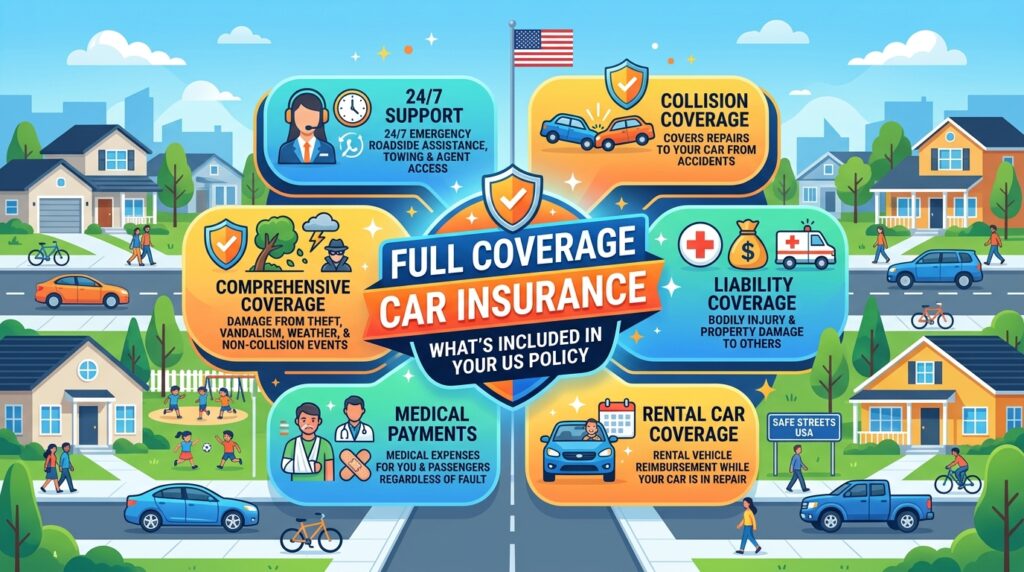
In America, weak credit directly means your car insurance bill skyrocketing. But if you understand the strategies of companies like State Farm, GEICO, Progressive, and USAA, you can save your hard-earned money from being robbed:
- Strength in Unity (Bundling Discount): If your premium is making you cry because of a bad Credit Score for Car Loan, get your car insurance done with the same company as your home (Home or Renters) insurance. Even if GEICO’s standalone car insurance seems a bit expensive, if they give a 15% discount for taking both insurances together, your total expense will be much lower than companies like Progressive. This is a very wise step to save the household budget.
- The Reward for Your Good Habit (Telematics): The best way to erase the stigma of your bad Credit Score for Car Loan is to prove your safe driving. Programs like Progressive’s ‘Snapshot’ or State Farm’s ‘Drive Safe & Save’ do not look at your old financial mistakes; instead, they look at how responsible you are on the road. If you drive safely with your family, your insurance bill can be reduced by 20% to 30%. This is the true reward of being a responsible human being!
- Where You Live Matters: In America, rules change in every state. States like California or Michigan have made strict laws to stop companies from looking at your Credit Score for Car Loan, which is a huge relief for the families living there.
- States with Heavy Penalties: But if you live with your family in states like Texas or Florida, your insurance can double due to a low Credit Score for Car Loan. In such a situation, definitely ask for local discounts according to your situation from carriers like State Farm.
- True Respect for Military Families: If you or any member of your family has served the country (Military/Veterans), go straight to USAA. They understand your struggle, and their policies protect your family’s rights the most.
When Loved Ones Become Your Support: Your Credit Score for Car Loan and the Bond of Relationships
When the burden of responsibility is heavy, the paths to buying a car seem closed, and your Credit Score for Car Loan leaves your side, then we look towards our family or a close friend with hopeful eyes. Truth be told, having the hand of a loved one on your shoulder during tough times is the world’s biggest comfort.
But wait a moment. Do you know that just a small word written on that lengthy dealership form can forever entangle that precious relationship and the ownership of your car? Asking for help from loved ones as a responsible person is absolutely right, but protecting that helper and yourself from any legal deception is your biggest responsibility. Let us understand how to rightfully make this trust of loved ones your strength.
Co-Signer vs. Co-Borrower: Choose Loved Ones, But With Complete Wisdom and Love
When your Credit Score for Car Loan is weak, bringing a loved one along is like a drowning man finding a straw. But before signing, understand the world of difference between these two terms:
1. Co-Signer (Your True Helper and Angel) A co-signer is that angel of the family whose own credit is excellent. They assure the bank, “I know this person; you can give them a loan without any worries.”
- The Car is Only Yours: The most beautiful thing is that the co-signer’s name is not on the car’s papers (Title). That car is entirely the asset of your family.
- Their Big Sacrifice: Despite the car not being theirs, they are 100% responsible for your debt. If you miss an installment, the bank will knock directly on their door. Remember, they have not just given you their name, but their reputation. Never let this trust break.
- Your Freedom: The car is in your name, so you can sell it whenever you want without asking them.
2. Co-Borrower (Legal Partner) This role is completely different.
- Sharing of Rights: The co-borrower’s name is recorded right next to your name on the car’s papers. They become half-owners of that car.
- Freedom Ends: Because they are legally half-owners, you can neither sell the car nor change the insurance without their written permission.
A Responsible Decision: If you want to learn from your past mistakes, improve your Credit Score for Car Loan, and want complete control over your car, then always choose the ‘co-signer’ option.
The Victory of Trust (Co-Signer Release): While taking the loan, definitely ask the bank for the condition of a ‘co-signer release’. Just think, when you pay every single installment with complete honesty and on time for the next 12 to 24 months, the bank legally removes the co-signer’s name from the debt. This is not just paperwork; it is the proudest moment of standing on your own two feet and setting that helper free with a smile!
Choose Family Safety, Not Show-off: Your Credit Score for Car Loan and the Right Car
Often people get so emotional seeing a fast and stylish car in the glitz of the showroom that they forget this car can ruin their household budget in the name of car insurance.
The Heavy Burden of Dangerous Cars: If your credit is already bad and you insist on getting showy cars like the Dodge Charger, Nissan Altima, or Hyundai Elantra, then this is a huge mistake. Police and insurance company statistics clearly show that these cars are stolen the most and are victims of horrific accidents.
Your weak Credit Score for Car Loan has already made you a ‘risk’ in the eyes of insurance companies. On top of that, if you bring a risky car, insurance companies will mercilessly increase your bill directly by up to 200%! Paying 200% more insurance just for a few moments of showing off cannot be the decision of a wise father or mother. This useless expense is a direct robbery of your children’s happiness.
A Wise and Safe Choice: To wash away the stigma of your bad credit, choose cars that are known for family safety, such as the Subaru Outback, Honda CR-V, or Toyota RAV4.
When insurance companies see that a person with a weak Credit Score for Car Loan is getting an extremely safe and family-oriented car, their algorithm also softens. The safety of the car suppresses the impact of your bad credit, and you get a massive relief in insurance every month.
The Magical Way to Save Taxes (Sales Tax Shield): Protecting Blood, Sweat, and Tears’ Earnings
When your Credit Score for Car Loan is weak, your first and firm rule should be: “To spread hands before the bank as little as possible.” This is where the tax rule of exchanging (Trade-in) an old car becomes a shield for you.
Understand This Math from the Perspective of a Parent: In states like Texas, Florida, or Illinois, there is a tax of about 6% to 10% on buying a car. Let us assume the tax is 8% in your area. The rule is that if you give an old car, the tax will not be levied on the full price, but only on the remaining amount.
- Suppose, you are buying a $25,000 car for your family.
- If you keep your old car at home, you will have to pay an 8% tax ($2,000) on the entire $25,000.
- But, if you show wisdom and exchange an old car worth $5,000, you will have to pay tax only on the remaining $20,000. This tax is reduced to only $1,600.
What Does This Really Mean for Your Family? On paper, it looks like you saved only $400. But the story does not end here. Since your Credit Score for Car Loan is low, your interest will be around 18%. If this $400 was added to your loan, you would be paying compound interest on it day and night for 5 years (60 months).
Meaning, by showing a little wisdom, you have actually saved your family $700! Just think, these $700 can be used for your household groceries, a medical emergency, or your children’s school fees. Do not let it go into the bank’s vault!
(Note: In states like California, Michigan, and Virginia, the tax is applied to the full price, so be sure to check the DMV website before leaving home.)
Conclusion: A New, Free, and Honorable Beginning
Getting a car with a bad Credit Score for Car Loan is certainly a struggle, but it is not your defeat. Gathering a 20% down payment, understanding your financial rights, and avoiding the tricks of deceitful (Buy Here, Pay Here) dealers is your real success.
Take the help of loved ones (Co-Signer), wisely get rid of the loss-making old car, and talk to the dealer only on the firm price (OTD). Most importantly, do not consider this expensive loan a punishment; it is a ladder to improve your Credit Score for Car Loan. Just pay every installment honestly for 6 to 12 months, and then take a new, cheaper loan (Refinance) to free yourself from this burden forever.
10 Important Questions Arising in Your Mind (FAQs)
- Question 1: What is a FICO Auto Score, and how is it different from my normal Credit Score for Car Loan?
- Answer: It does not just look at your general debt, but tells the bank how responsible you will prove to be towards your family in paying your car installments.
- Question 2: How will falling into the ‘deep subprime’ list affect my budget?
- Answer: It puts you in that difficult situation where banks mercilessly charge heavy interest from 15% to 21%+, which can squeeze years of your savings.
- Question 3: Why is it so important to give a 20% down payment even with a bad Credit Score for Car Loan?
- Answer: When you put in your own savings money, the banks’ fear is eliminated. Because of this, you get the loan quickly and you avoid drowning in debt more than the actual price of the car.
- Question 4: What firm documents do banks ask for a subprime loan?
- Answer: They want to see your steady income. Therefore, definitely carry your salary slips for the last 30 days, W-2 forms for 2 years, and a recent electricity/water bill of your home address.
- Question 5: What is the real difference between a co-signer and a co-borrower?
- Answer: A co-signer is your true friend who gives a guarantee but does not claim any right on the car. Whereas a co-borrower legally becomes half-owner of your car.
- Question 6: Why is it important to stay away from “Buy Here, Pay Here” dealers?
- Answer: Taking advantage of your helplessness, they sell cars at higher prices, charge the highest interest, and shut down the car with a machine (GPS) if an installment is even one day late. Most sadly, they do not report your honestly paid installments, due to which your Credit Score for Car Loan never improves.
- Question 7: How does the dealer’s “monthly installment” ‘four square’ trick work?
- Answer: They smile and agree to your desired cheap installment, but secretly push you into a 72 to 84 months (almost 7 years) long debt, keeping you trapped in the net of useless interest.
- Question 8: What is the deception of “Yo-Yo Financing” and how do I protect my family from it?
- Answer: Dealers let you take the car home on a pending approval, and then a few days later, making the excuse of the loan being canceled, pressure you to sign expensive papers. Only take the car out of the showroom when the loan is 100% firm.
- Question 9: Why is adding the debt of the old car to the new car (Negative Equity) a sweet poison?
- Answer: It directly means that by adding the remaining debt of your old car into the loan of the new car, you are paying a heavy interest of 18%+ on it—that too for a car that you do not even have anymore! This is a waste of money.
- Question 10: What is the right path to get freedom (refinance) from this expensive debt after 6 to 12 months?
- Answer: Do not miss a single installment for the next 6 to 12 months. As soon as your Credit Score for Car Loan improves with this honesty, immediately go to a credit union, take a cheaper loan, and say a permanent goodbye to the old expensive bank.